Analytic combinatorics uses techniques from complex analysis to solve problems in enumerative combinatorics, specifically to find asymptotic estimates for the coefficients of generating functions.
History
One of the earliest uses of analytic techniques for an enumeration problem came from Srinivasa Ramanujan and G. H. Hardy's work on integer partitions, starting in 1918, first using a Tauberian theorem and later the circle method.
Walter Hayman's 1956 paper "A Generalisation of Stirling's Formula" is considered one of the earliest examples of the saddle-point method.
In 1990, Philippe Flajolet and Andrew Odlyzko developed the theory of singularity analysis.
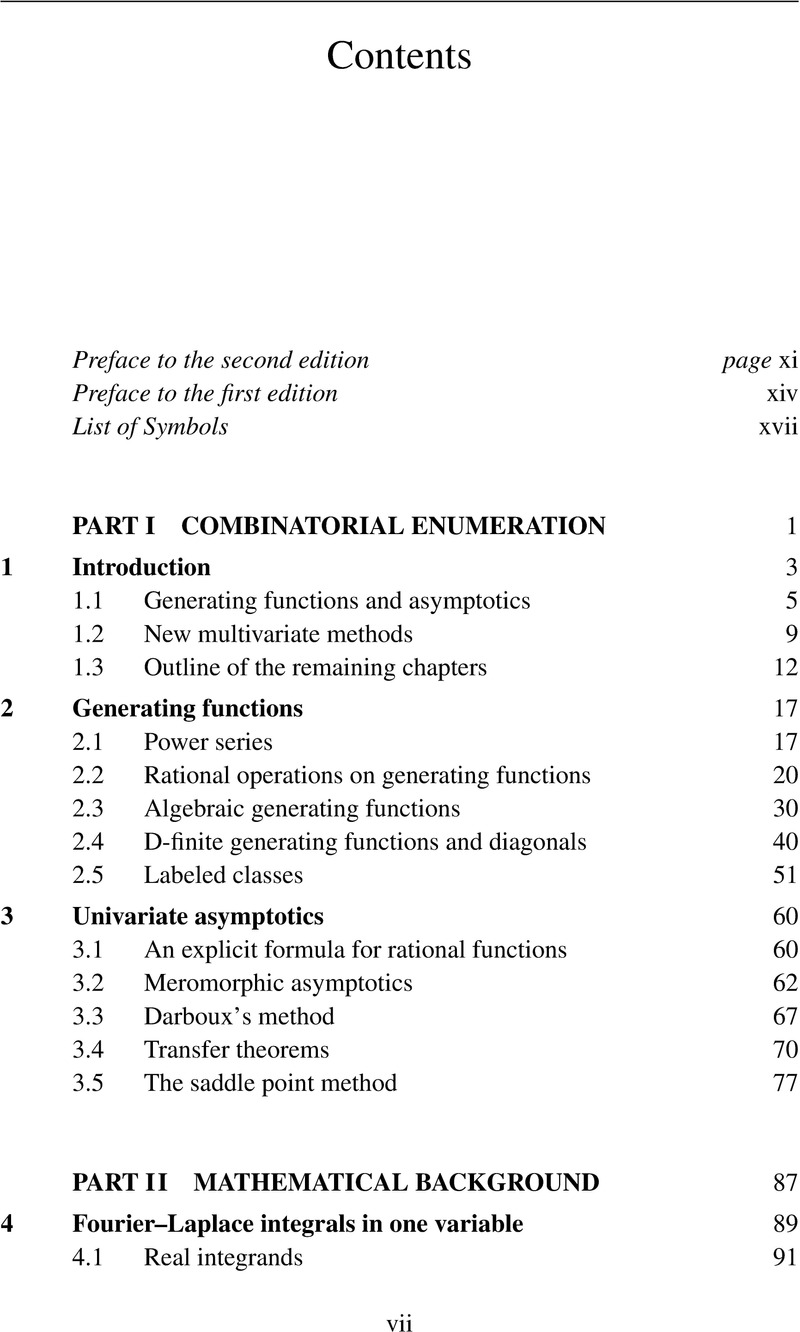
In 2009, Philippe Flajolet and Robert Sedgewick wrote the book Analytic Combinatorics, which presents analytic combinatorics with their viewpoint and notation.
Some of the earliest work on multivariate generating functions started in the 1970s using probabilistic methods.
Development of further multivariate techniques started in the early 2000s.
Techniques
Meromorphic functions
If is a meromorphic function and is its pole closest to the origin with order , then
- as
Tauberian theorem
If
- as
where and is a slowly varying function, then
- as
See also the Hardy–Littlewood Tauberian theorem.
Circle Method
For generating functions with logarithms or roots, which have branch singularities.
Darboux's method
If we have a function where and has a radius of convergence greater than and a Taylor expansion near 1 of , then
See Szegő (1975) for a similar theorem dealing with multiple singularities.
Singularity analysis
If has a singularity at and
- as
where then
- as
Saddle-point method
For generating functions including entire functions which have no singularities.
Intuitively, the biggest contribution to the contour integral is around the saddle point and estimating near the saddle-point gives us an estimate for the whole contour.
If is an admissible function, then
- as
where .
See also the method of steepest descent.
Notes
References
- Flajolet, Philippe; Sedgewick, Robert (2009). Analytic Combinatorics (PDF). Cambridge University Press.
- Hardy, G.H. (1949). Divergent Series (1st ed.). Oxford University Press.
- Melczer, Stephen (2021). An Invitation to Analytic Combinatorics: From One to Several Variables (PDF). Springer Texts & Monographs in Symbolic Computation.
- Pemantle, Robin; Wilson, Mark C. (2013). Analytic Combinatorics in Several Variables (PDF). Cambridge University Press.
- Sedgewick, Robert. "4. Complex Analysis, Rational and Meromorphic Asymptotics" (PDF). Retrieved 4 November 2023.
- Sedgewick, Robert. "8. Saddle-Point Asymptotics" (PDF). Retrieved 4 November 2023.
- Szegő, Gabor (1975). Orthogonal Polynomials (4th ed.). American Mathematical Society.
- Wilf, Herbert S. (2006). Generatingfunctionology (PDF) (3rd ed.). A K Peters, Ltd.
As of 4th November 2023, this article is derived in whole or in part from Wikibooks. The copyright holder has licensed the content in a manner that permits reuse under CC BY-SA 3.0 and GFDL. All relevant terms must be followed.
Further reading
- De Bruijn, N.G. (1981). Asymptotic Methods in Analysis. Dover Publications.
- Flajolet, Philippe; Odlyzko, Andrew (1990). "Singularity analysis of generating functions" (PDF). SIAM Journal on Discrete Mathematics. 1990 (3).
- Mishna, Marni (2020). Analytic Combinatorics: A Multidimensional Approach. Taylor & Francis Group, LLC.
- Pemantle, Robin; Wilson, Mark C.; Melczer, Stephen (2024). Analytic Combinatorics in Several Variables (PDF) (2nd ed.). Cambridge University Press.
- Sedgewick, Robert. "6. Singularity Analysis" (PDF).
- Wong, R. (2001). Asymptotic Approximations of Integrals. Society for Industrial and Applied Mathematics.
External links
- Analytic Combinatorics online course
- An Introduction to the Analysis of Algorithms online course
- Analytic Combinatorics in Several Variables projects
- An Invitation to Analytic Combinatorics
See also
- Symbolic method (combinatorics)
- Analytic Combinatorics (book)